
Earlier this month, I received a call from a journalist at Up18 News who wanted to talk about interior photography — not the technical side, but the psychology behind it. Why do certain images of a space make people stop scrolling? Why do some rooms photograph beautifully and still leave buyers cold? What actually happens in the mind of a person who falls in love with a home they have never visited?
These are questions I have been sitting with for over two decades. So when the feature went live, it felt less like coverage and more like a conversation that had finally found the right room.
These are questions I have been sitting with for over two decades. So when the feature went live, it felt less like coverage and more like a conversation that had finally found the right room.
"Photography is not about the room. It is about the feeling the room leaves behind." — Ranjan Bhattacharya
What the Feature Was About
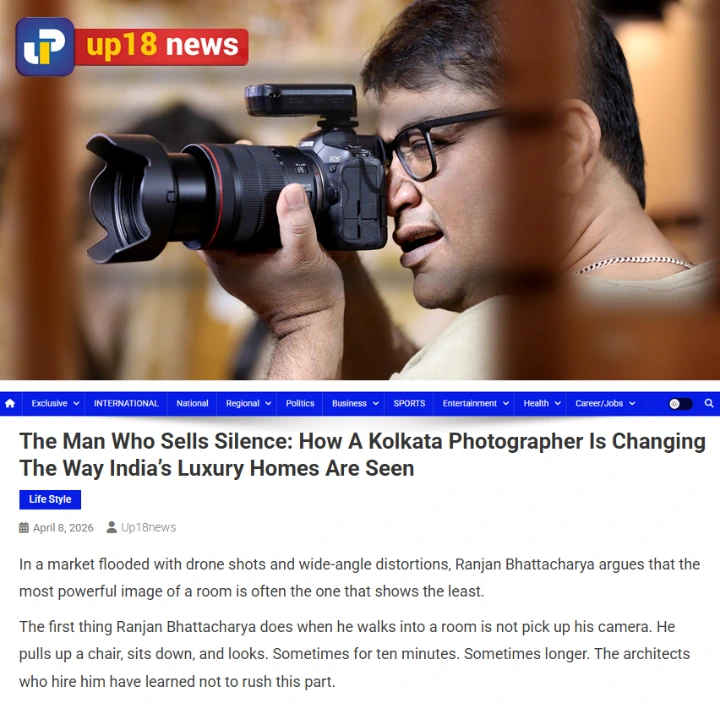
The Up18 News piece — titled The Man Who Sells Silence: How a Kolkata Photographer Is Changing the Way India's Luxury Homes Are Seen — focused on a shift that anyone working in India's premium real estate will recognise immediately.
Luxury homebuyers in 2026 are no longer walking into a property and deciding on the spot. They are researching online for weeks, sometimes months, before they ever schedule a site visit. And the images they see during that research — on developer websites, on Instagram, on property portals — are often the real deciding factor. Not the marble flooring. Not the view. The photograph of the marble flooring. The photograph of the view.
This is the environment I have been working in for the past 24 years. And what the article captured well is something I try to explain to every developer and designer I work with: a photograph of a luxury space is not documentation. It is the first conversation between that space and its future owner.
Why Visual Psychology Matters in Real Estate Photography
The feature touched on something I explore in depth in my work — the idea that human beings do not see spaces the way cameras do. Our eyes are constantly moving, adjusting, reading peripheral cues, responding to light temperature, and interpreting depth and scale in ways that a single frame cannot naturally replicate.
Standard property photography tries to compensate for this by going wider, brighter, and more saturated. The result is images that look impressive at a glance but feel somehow hollow — because the brain immediately registers that something is off. The proportions do not match what we expect from experience. The light does not behave the way real light does. We scroll past.
The approach I have developed over the years works in the opposite direction. Instead of exaggerating a space, I try to distil it — to find the one or two qualities that make that particular room worth remembering, and build the composition around those. Sometimes it is the quality of morning light on a textured wall. Sometimes it is the visual weight of a piece of furniture against an empty volume. Sometimes it is simply the silence of a well-proportioned room.
"The most powerful interior photograph is often the one that shows the least — because it trusts the viewer to feel the rest."
The Demand for Thoughtful Interior Photography Is Growing
What struck me about the Up18 News feature was the context it placed my work in — the broader transformation of India's luxury real estate and interior design market.
Developers across metros are now investing heavily in wellness-integrated layouts, biophilic design elements, and smart home ecosystems. Interior designers are working with materials and textures that would have been considered unusually refined even five years ago. The standard of the built environment has risen considerably.
But the visual documentation of these spaces has not kept pace. There is still a significant gap between the quality of what is being built and the quality of how it is being shown. And that gap costs developers real money — in slower sales cycles, lower inquiry rates, and buyers who visit a property with reduced expectations because the images did not do justice to the space.
This is the gap I have spent my career trying to close. Not just for residential developers, but for commercial spaces, hospitality projects, and interior design studios that need their portfolio to communicate at the same level as their craft.
A Note on the Work Itself
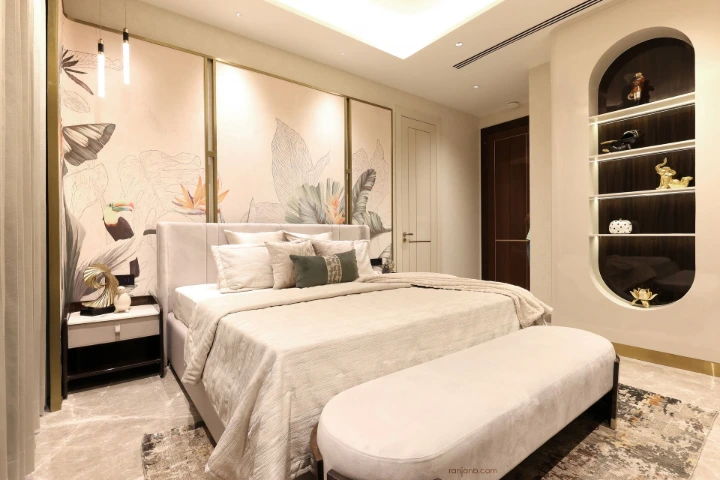
The feature referenced several projects across eastern and southern India — office redesigns, boutique hotel interiors, and high-end residential work. What connects them, regardless of scale or style, is the same underlying intention: to make a viewer feel present in a space they are only looking at.
That requires patience more than equipment. It requires understanding not just how a room is designed, but why it was designed that way — what experience the architect or designer intended, and how to make that intention visible in a single frame.
It also requires an honest conversation with every client about what their images are actually for. Are they selling a property? Building a design portfolio? Attracting corporate tenants? The answer changes everything — the time of day we shoot, the staging, the perspective, the mood.
Read the Full Feature
If you are a developer, architect, or interior designer looking to document your next project with the same level of intention, I would be glad to talk. You can explore my interior photography services here or reach out directly through the contact page.